How should you dress for an Antarctic expedition? What gear do you need to pack? Here is our expert advice and a checklist of personal items to prepare before setting sail.
During your expedition, you will make landings daily—often several times a day when conditions allow. Being dressed comfortably in clothing suited to polar temperatures is crucial.
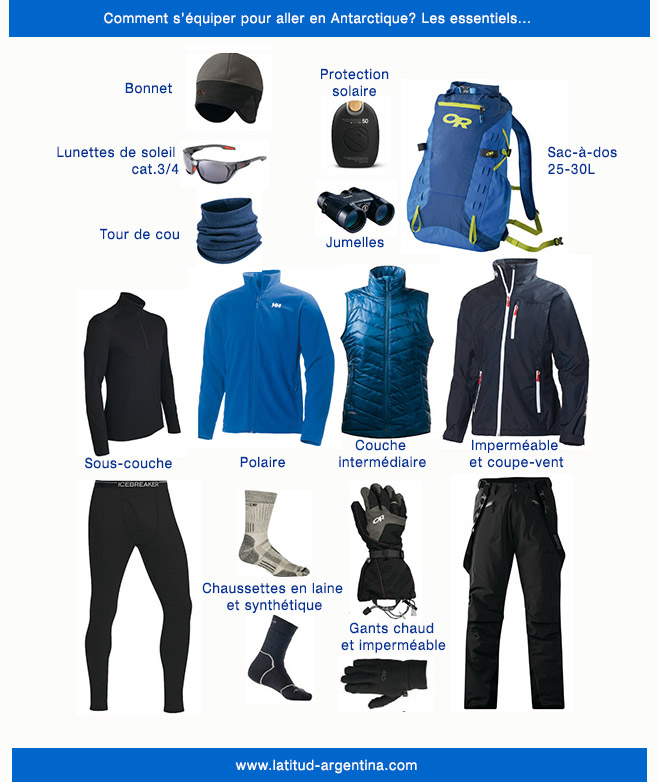
A polar expedition cruise requires a well-thought-out selection of clothing. On land, expect temperatures ranging from -5°C to 5°C (23°F to 41°F). Out on the ocean—watching wildlife from the open decks—temperatures will rarely climb above 2°C (35°F). Add a biting, often damp polar wind, and the vital need for warm, waterproof clothing, gloves, and beanies becomes crystal clear.
What is the ultimate secret to staying warm in Antarctica? Layering! Layers trap insulating air, allowing you to easily regulate your temperature whether you are active or standing still.
Technical, high-performance clothing is essential for this adventure. Choose lightweight technical fabrics engineered to wick away moisture and keep you warm and dry. From the inside out, think of a warm wool base layer, a fleece or sweater as an insulating mid-layer, and a windproof, waterproof outer shell jacket.
For your legs: a wool base layer, tightly woven outdoor trousers as a mid-layer, and wind- and waterproof shell pants on the outside.
A pair of sturdy, non-slip walking shoes is ideal for moving around on board and perfect for dry landings.
On board, the dress code is relaxed and casual. Focus on practical clothing and comfortable flat shoes for walking around the ship. However, some guests enjoy dressing up a little for dinner.
How to Dress for Antarctica
Head
- Beanie + fleece neck gaiter
- Polarized sunglasses
- Sunscreen (minimum SPF 30)
- Hydrating lip balm with UV protection
Upper Body
- Base layer: long-sleeved top made of silk or synthetic thermal fabric (such as Thermolactyl)
- Mid-layer: Heavyweight 300 fleece or thick wool sweater
- Outer protection: Extreme cold expedition parka / fully waterproof and windproof
Hands
- Silk or merino wool glove liners
- Waterproof ski/mountaineering gloves or mittens
Lower Body
- Base layer: Silk or merino wool thermal leggings
- Mid/Outer layer: Warm, waterproof expedition pants
Feet
- Silk or merino wool liner socks
- Heavyweight wool or ski socks
- Waterproof, non-slip rubber expedition boots (provided on board)
Golden Rules:
Always think in 3 layers (base layer next to skin, insulating mid-layer, protective outer shell)
Breathable technical fabrics only (strictly no cotton!)
Fully waterproof garments (water-repellent is not enough)
Protect your extremities thoroughly (fingers, toes, ears...)
Essential Accessories to Pack
- Pair of binoculars
- Telescopic trekking pole
- Extra camera batteries (cold drains them fast)
- Extra memory cards / photo storage drive
- A small waterproof daypack to keep your hands free (around 25L)
Life on Board
Onboard Dress Code
In keeping with our expedition spirit, life on board is informal. Pack casual, comfortable clothing for all daily activities. Keep in mind that much of the spectacular scenery is best enjoyed out on the open deck, which can be wet and slippery. Bring sturdy shoes with non-slip soles, and make sure your parka is always within arm's reach in case a "Whales!" announcement comes over the PA system and you need to rush outside. Dress in layers, as the ship's interior is comfortably warm while the outer decks are crisp and cold.
Physical Fitness
You should be in good general health and capable of walking comfortably for several hours a day. While this is an expedition cruise and not overly physically demanding, our focus is on spending as much time ashore as possible—though you are always welcome to relax on board if you prefer.
To take part in most excursions, you must be able to climb down and up the steep gangway between the ship and the water to board the Zodiacs. Our expedition team will assist you in and out of the boats; with a little practice, it quickly becomes second nature.
Ashore, terrain is wild, rocky, snow-covered, and potentially slippery. You are traveling through remote wilderness far from advanced medical facilities; therefore, you should not embark on this expedition if you have a life-threatening condition or require daily specialized medical care.
Gratuities
Tipping for the ship's crew and expedition staff is traditionally handled as a lump-sum contribution at the end of the voyage, divided among the crew members. Tipping is entirely personal and at your own discretion. As a standard guideline in expedition cruising, we suggest 8 to 10 USD per person, per day. Cash in US dollars is the preferred method for the crew.
Smoking Policy
For safety and comfort, our vessels operate a strict no-smoking policy throughout all interior spaces. Smoking is only permitted in designated open-air deck areas. Please be mindful and respectful of non-smoking fellow adventurers.
Have a question about these expeditions, need bespoke advice, or wish to receive a quote?
Our team of polar specialists is here to guide you.
Do not hesitate to reach out: we are always delighted to assist and will respond promptly.